
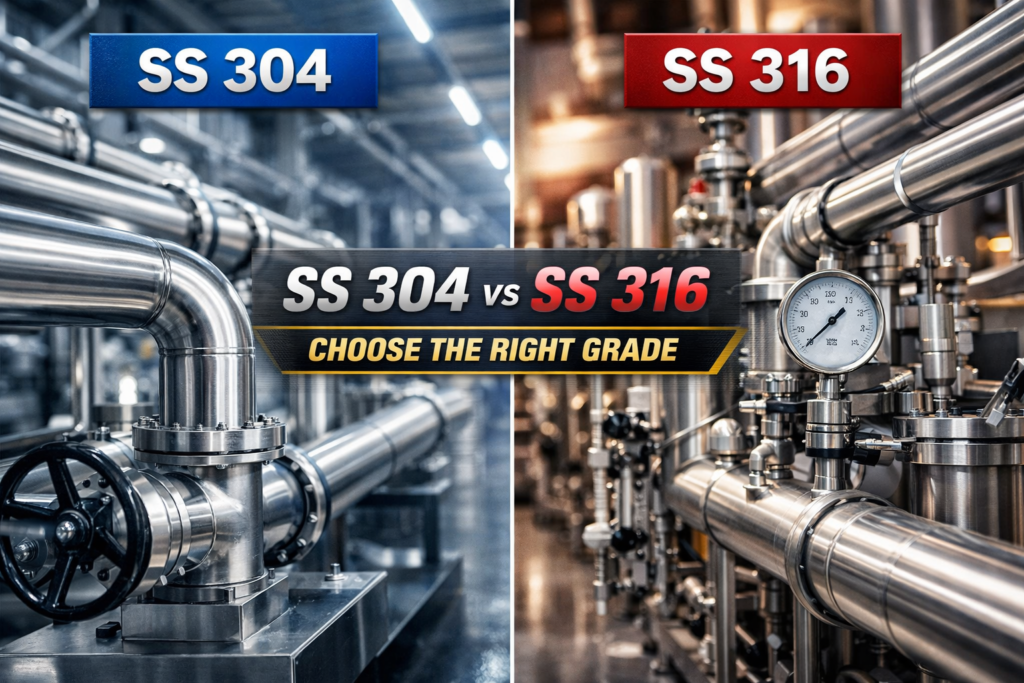
In Pakistan’s industrial and construction sectors, stainless steel is widely used but often misused. One of the most common mistakes in projects is selecting the wrong stainless steel grade, usually between SS 304 and SS 316.
At first glance, both grades look similar. However, their performance, lifespan, and suitability can differ significantly depending on the environment. Choosing incorrectly can result in corrosion, contamination, premature failure, and higher long-term costs.
This guide explains the practical difference between SS 304 and SS 316, and when each grade should be used in real industrial conditions.
Understanding Stainless Steel Grades
Stainless steel grades are defined by their chemical composition. Small changes in alloying elements can create big differences in performance.
SS 304, The General-Purpose Workhorse
SS 304 is the most commonly used stainless steel grade worldwide. It offers a strong balance of strength, corrosion resistance, and affordability.
Key Characteristics:
Good resistance to rust and oxidation
Suitable for normal indoor and outdoor environments
Easy to fabricate and weld
Cost-effective for large projects
Common Applications:
Water pipelines and storage tanks
Structural fabrication
Food handling equipment (non-aggressive environments)
General industrial and construction use
SS 304 performs well where exposure to chemicals, salt, or aggressive cleaning agents is limited.
SS 316, Built for Harsh Conditions
SS 316 contains molybdenum, an additional alloying element that significantly improves resistance to corrosion—especially from chemicals and chlorides.
Key Characteristics:
Superior resistance to chemicals and acids
Better performance in humid, coastal, or saline environments
Longer service life under harsh conditions
Common Applications:
Pharmaceutical manufacturing
Chemical processing plants
Food processing with aggressive cleaning cycles
Coastal, marine, and high-humidity environments
While SS 316 costs more than SS 304, it often proves more economical over time due to reduced maintenance and longer durability.
Why the Right Choice Matters in Pakistan
Pakistan’s industrial conditions are demanding. High temperatures, humidity, chemical exposure, and inconsistent maintenance schedules can quickly damage low-grade materials.
Using SS 304 where SS 316 is required may lead to:
Surface corrosion and pitting
Contamination risks in food or pharma applications
Frequent repairs and downtime
On the other hand, using SS 316 where SS 304 is sufficient can unnecessarily increase project costs.
The right decision depends on application, environment, and lifecycle cost, not just initial price.
Quick Selection Guide
Normal industrial or construction use → SS 304
Food, pharmaceutical, or chemical exposure → SS 316
High humidity or coastal areas → SS 316
Budget-controlled, non-aggressive environments → SS 304
Importance of Quality & Sourcing
Grade selection alone is not enough. Poor-quality or uncertified stainless steel can fail even if the grade is correct.
Imported stainless steel manufactured under international standards (such as ASTM specifications) offers:
Consistent composition
Better mechanical strength
Predictable performance
This is especially critical for piping systems, pressure applications, and hygienic installations.
Final Thoughts
SS 304 and SS 316 are both excellent materials but only when used correctly.
Understanding where each grade performs best helps engineers, contractors, and procurement teams avoid costly mistakes and ensure long-term reliability.
At Saify Iron & Cement Mart, we work closely with industrial clients across Pakistan to help them select stainless steel materials that match their application, environment, and budget without compromise on quality.